Home - Furniture - Garden
Bamboo has moved far beyond its image as a fast‑growing plant used for garden stakes and decorative pieces. Over the last two decades, it has become a dependable material for builders, designers, and manufacturers. Among its many applications, bamboo plywood has gained particular attention thanks to its strength, stability, and clean appearance. Although it resembles traditional hardwood plywood, it has unique characteristics that come from the structure of the bamboo stalk and the way the material is processed.
This article takes a close look at what bamboo plywood is, the types available, how grading works, and where you’ll commonly see it used. Along the way, we touch on factors that can help you choose the right product for different projects and understand why bamboo plywood performs the way it does.
Understanding Bamboo Plywood
Bamboo plywood is made by slicing the stalk of the bamboo plant into thin strips, removing the outer layer, and laminating the strips together under pressure with adhesives. These laminations create large, stable panels similar to those produced from hardwood veneers, but with the distinctive linear grain that bamboo is known for.
Because bamboo is a grass rather than a tree, its fibers run vertically and densely along the culm. This creates a material with impressive tensile strength. When the fibers are laminated horizontally or vertically, the resulting panels can resist warping, shrinking, and swelling more effectively than many traditional hardwood plywood products.
Another aspect that sets bamboo plywood apart is its sustainability profile. Bamboo grows rapidly—often reaching maturity in four to six years—and regenerates from its own root system. This allows for frequent harvesting without soil disruption or replanting, which can be appealing for environmentally conscious projects.
Common Types of Bamboo Plywood
The performance and appearance of bamboo plywood depend heavily on how the strips are oriented during lamination. These are the primary types you’ll encounter:
1. Horizontal Bamboo Plywood
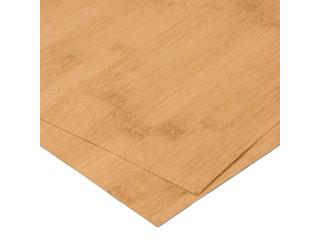
Strips are laid flat, revealing the characteristic “knuckle” pattern of bamboo nodes across the surface. This type shows more of the bamboo’s natural personality and works well for visible applications such as cabinetry faces, shelving, and wall panels.
2. Vertical Bamboo Plywood
In this style, the narrow edges of the strips face upward, creating a fine, uniform grain with minimal node patterns. Vertical panels are often chosen for a clean, modern look, especially in furniture, interior finishes, and decorative elements.
3. Strand-Woven Bamboo Plywood
Strands of bamboo are shredded, infused with resin, and compressed into dense sheets. This version is known for exceptional hardness and durability, often surpassing many hardwoods. It’s commonly used where high impact resistance or heavy daily wear is expected.
4. Carbonized Bamboo Plywood
Carbonized panels achieve their warm, caramel color through heat treatment rather than a surface stain. This process darkens the fibers throughout the panel, resulting in a richer tone. While carbonization slightly reduces hardness, the aesthetic trade‑off is often worth it for designers seeking a warm, consistent hue.
5. Natural Bamboo Plywood
This is the raw, untreated color of bamboo—typically a pale, blonde tone. Its light appearance makes it an excellent choice for Scandinavian‑inspired and minimalistic spaces where brightness and neutrality matter.


